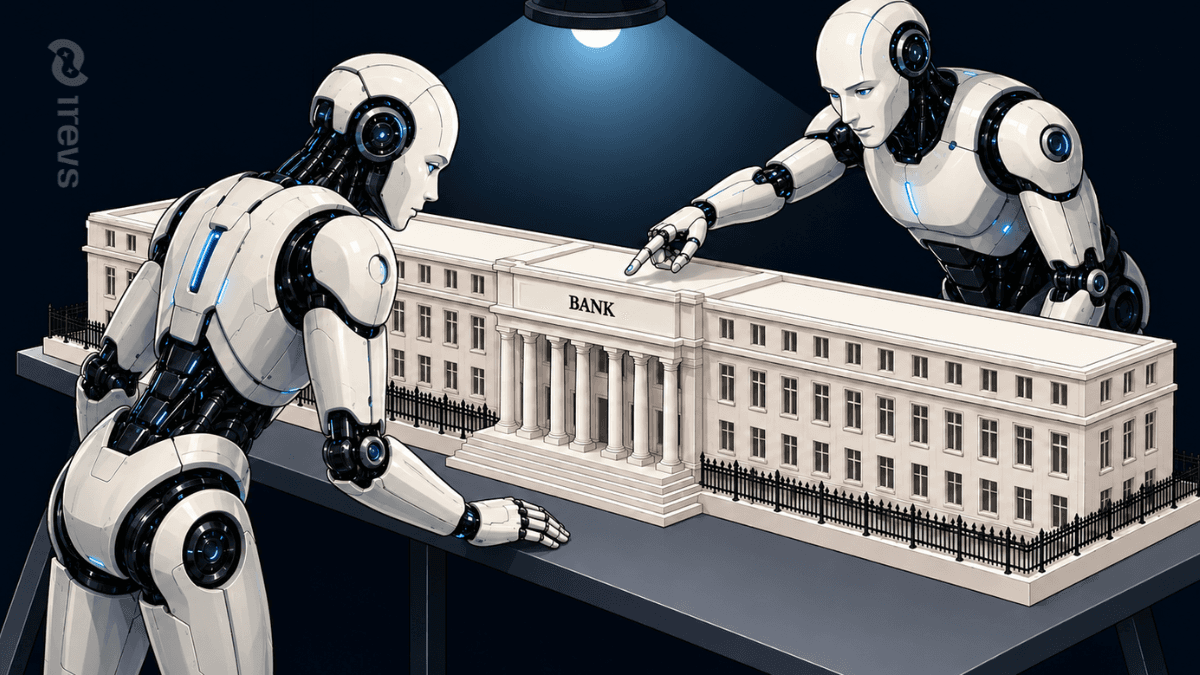
Senior officials at some of the world's most influential financial institutions say regulation is losing ground to artificial intelligence, and they're now questioning whether markets need built-in emergency brakes to survive an AI-driven shock.
The warning came out of a gathering of central bankers in Sintra, Portugal, where policymakers from the Bank of England, the European Central Bank, and the International Monetary Fund each raised similar concerns from different angles: AI is moving faster than the rules meant to contain it, and the financial system may not be ready for what comes next.
Bank of England Deputy Governor Sarah Breeden zeroed in on what happens when autonomous, or agentic, AI systems start making trading decisions without a human checking their work, in a speech at the European Central Bank's Sintra forum on central banking. She raised the idea of building safeguards similar to circuit breakers or kill switches that could pause trading across the market if an AI model malfunctioned and started making bad calls at scale.
The concern isn't hypothetical. Agentic AI is designed to act independently, executing trades, rebalancing portfolios, or reacting to news in real time. If several of these systems misread the same signal at once, the effect could ripple through markets far faster than any human trading desk could correct.
Breeden also pointed to a less-discussed risk: how much borrowing is now tied to AI-related investment. As debt financing linked to AI infrastructure grows, she said the financial fallout from any sharp drop in AI asset values could be more severe than markets currently assume.
That view aligns with a recent warning in the Bank for International Settlements' annual economic report, which cautioned that AI-driven enthusiasm could be setting up a debt-fueled boom that ends in a hard correction, especially if central banks are forced to raise interest rates to fight inflation. That same buildout is already straining local energy and water supplies around the data centers behind it.
The IMF's Tobias Adrian, who heads its Monetary and Capital Markets Department, framed it as a maturity mismatch, saying much of the debt hyperscalers are raising to build AI infrastructure carries longer maturities than the useful life of the chips and data centers it's paying for. GPUs can become outdated within just a few years, so if AI returns fall short before that infrastructure pays for itself, companies could be left repaying long-term debt on assets that have already lost their value.
That borrowing pattern isn't limited to the usual hyperscalers, either. Nvidia's own $20 billion bond sale, and the bitcoin miners quietly following its lead into AI infrastructure show just how far this debt-funded buildout now reaches.
European Central Bank President Christine Lagarde didn't mince words either, calling the pace of AI development a major risk to financial stability, one that's arguably outpacing even the cybersecurity threats regulators have spent the last decade trying to manage, in comments to French outlet Les Échos.
Meanwhile, Nikhil Rathi, who leads the UK's Financial Conduct Authority, said the traditional approach to writing financial rules simply doesn't work anymore, telling CNBC's Squawk Box Europe that AI tools are evolving in weeks, not years. Rathi suggested that regulators need a more collaborative, faster-moving relationship with the market rather than the usual multi-year rule making cycle.
There's also a competitive tension underneath all of this. Much of the frontier AI investment and model development is happening in the US, where deeper equity markets give companies more room to raise capital for AI expansion. Europe's financial system doesn't have the same depth of capital channels, which puts regulators in a difficult spot: move too cautiously, and AI firms may simply take their business and their compliance costs elsewhere.
Between the Bank of England's kill-switch proposal, the BIS and IMF's debt warnings, and the FCA and ECB's admission that rule making can't keep pace, the officials gathered at Sintra converged on the same underlying point: the tools built to manage risk in modern markets weren't designed for a system where machines can make and execute financial decisions on their own. It's a concern that echoes JPMorgan's own recent warning about a potential $165 billion stock-selling wave tied to portfolio rebalancing, another sign that big, fast-moving capital shifts are increasingly on regulators' minds.
Central bankers at the ECB Forum in Portugal discussed AI's risks to financial stability, employment, and inflation, with concerns about its impact on markets and lending reut.rs/4gcLF10