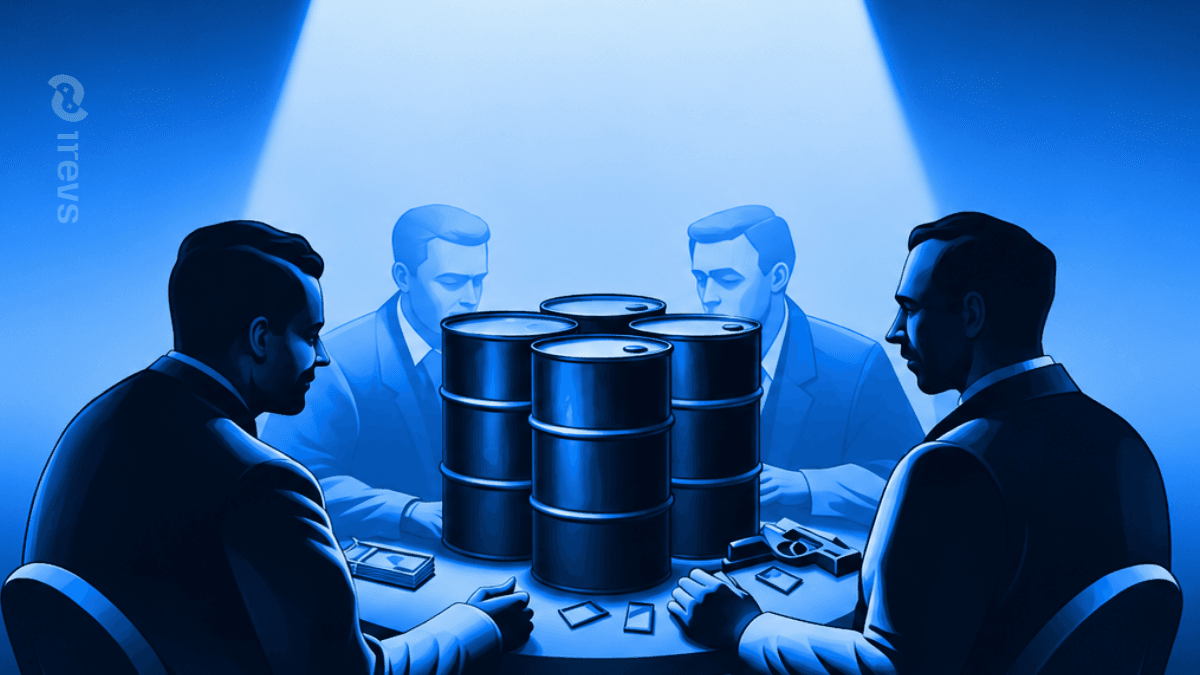
The conflict in Iran has effectively closed the Strait of Hormuz, the world's most critical oil chokepoint, pushing Brent crude toward $100 per barrel. Rising oil prices are pulling stock markets lower, spiking European energy bills, and generating investor uncertainty not seen since the Gulf War of 1991.
Markets initially expected oil to jump sharply the moment the conflict broke out. Instead, Brent crude rose to around $80 on the announcement and traded sideways between $80 and $85 for three days. The reason was the market's expectation of a quick resolution following the removal of the supreme leader on the first day. As the week progressed and it became clear the Strait would not be safe for shipping for some time, oil climbed to approximately $95 per barrel.
One factor has been temporarily suppressing prices. An estimated 100 million barrels of sanctioned crude are currently sitting on tankers near the South China Sea, acting as a pressure valve. This buffer is finite. If the conflict extends beyond roughly 10 days, that supply is absorbed, and the market faces a genuine structural shortfall.
Every day the Strait remains closed, the world loses an estimated 10 million barrels of oil supply. Duration is the single most important variable in this story. The longer the conflict lasts, the higher the prices will go.
The Strait of Hormuz carries approximately 20 million barrels of oil per day, roughly one-fifth of global consumption, through a narrow waterway between Iran and Oman. Iranian drone and missile threats have made the passage commercially uninsurable. Ships are not moving.
Saudi Arabia's east-to-west pipeline can reroute up to 5 million barrels per day. All alternative routes combined add some additional capacity. Even with every workaround in place, roughly 10 million barrels per day remain stranded. The United States has promised Navy escorts and insurance backing for vessels transiting the Strait, but implementation will take time.
Oil is not the only commodity disrupted. Qatar has suspended operations at its flagship LNG production facility, the world's largest, due to the ongoing missile threat. After Russia's 2022 invasion of Ukraine, European governments spent years redirecting their energy supply chains toward Qatari LNG. That strategy has been partially dismantled overnight.
European natural gas prices have spiked sharply. Production at the Qatari facility is expected to take at least a month to fully restore. This creates a divergence between US and European equity performance, as American companies have less exposure to European gas prices and benefit from the US being a significant oil exporter.
Analysing every major geopolitical shock since World War II, the data shows a consistent pattern. The median equity sell-off lasts 15 trading days. The median time to recover to pre-crisis levels is 16 trading days. The average peak-to-trough decline is 5.7%. The S&P 500 has averaged a 13% gain in the 12 months following the bottom of a geopolitical sell-off.
The most relevant comparison is the Gulf War of 1990 to 1991. Oil rose from $15 to $40 per barrel. The MSCI World Index fell 25% at its worst point. Investors who bought during peak fear were rewarded as the conflict resolved. The MSCI World Index is currently down approximately 5% from its peak, meaning a significant portion of downside risk remains, but so does the buying opportunity that follows.
Scenario 1: Oil at $95 (current)
Begin cautious, scaled entry into equities. The worst-case drawdown comparable to the Gulf War's 20% decline remains possible. Start small and build gradually.
Scenario 2: Oil at $100, MSCI World at the 200-day moving average (-6.5%)
Increase equity exposure more meaningfully. This level represents a statistically significant support zone. Begin taking partial profits on any long oil positions as the risk/reward starts to shift.
Scenario 3: Oil at $120 to $130, equities down 10 to 20%
This is the maximum fear scenario. Historically, this is when aggressive buying of risk assets has generated the strongest subsequent returns. The long-term bull market drivers remain intact; this is a cyclical disruption, not a structural break.
Investors who attempt to call the exact bottom consistently underperform those who scale in systematically across multiple entry points. European and emerging market stocks are currently underperforming significantly. When this conflict is resolved, those markets stand to benefit most from a snapback.
Gold initially rallied when the conflict broke out and has since pulled back as investors took profits. The structural case for gold remains intact. Each additional geopolitical intervention adds to the risk premium embedded in global markets, and gold is the most direct beneficiary of that premium over time.
Bonds have not provided the expected flight-to-safety rally. Bond yields have actually risen since hostilities began, reflecting the inflationary signal of higher oil prices. If oil pushes toward $120 to $130, debate over Federal Reserve rate increases could emerge, which would be negative for both bonds and equities. That combination historically marks peak fear and the best buying opportunities. Bonds may become more attractive once oil peaks and begins declining.
The case for a short resolution is credible. Iran's Supreme Leader is reportedly dead. The Iranian Navy and Air Force have been largely destroyed. Economic pressure on Tehran is intensifying. China, Iran's most important trade partner, has a powerful incentive to broker a ceasefire since the Strait closure directly threatens its own oil supply.
President Trump has publicly described this as a four- to five-week campaign. Markets are currently pricing something closer to the short end of that range. The risk of prolongation is real, however. Iran still has substantial stocks of short-range missiles and drones, and the fate of the Iranian Revolutionary Guard remains uncertain.
The base case is weeks, not months. Investors should be prepared for the scenario where this extends further.
For broader context on how energy prices are intersecting with financial markets and investor positioning, see JPMorgan's $165 Billion Rebalancing Warning and Why Americans Are Still Paying High Gas Prices Despite Falling Crude Oil.
This article represents market analysis and editorial opinion. It does not constitute personalised financial advice. Past performance during geopolitical crises does not guarantee future results. Consult a qualified financial advisor before making investment decisions.